AERO-ACOUSTIC MILLING PLANT
ARIA Aero-Acoustic Milling Plants converts industrial by-products such as fly ash, granulated blast furnace slag (GBFS), and waste glass into high-quality Supplementary Cementitious Materials (SCMs). The process utilises ARIA’s Aero acoustic milling technology to selectively micronise feed materials through high-velocity vortex airflow and particle-to-particle collisions. As a result, the technology produces ultra-fine, highly reactive SCMs without the excessive energy consumption associated with conventional grinding systems.
Furthermore, the ARIA process improves particle size distribution, increases surface area, and enhances pozzolanic reactivity. These characteristics enable the production of premium SCMs suitable for cement, concrete, and construction applications. Consequently, manufacturers can reduce clinker consumption, lower carbon emissions, and improve the performance of finished products.
In addition, the technology transforms industrial waste into valuable construction materials, creating a sustainable waste-to-value pathway. By diverting fly ash, GBFS, and waste glass from disposal facilities, ARIA Aero acoustic milling technology supports circular economy principles and resource efficiency. As industries seek low-carbon building materials, the technology provides a commercially attractive solution that improves profitability, reduces environmental impact, and maximises value recovery from industrial waste streams.
EXPLORE THE WASTE TO VALUE PLANT OPTIONS OF ARIA
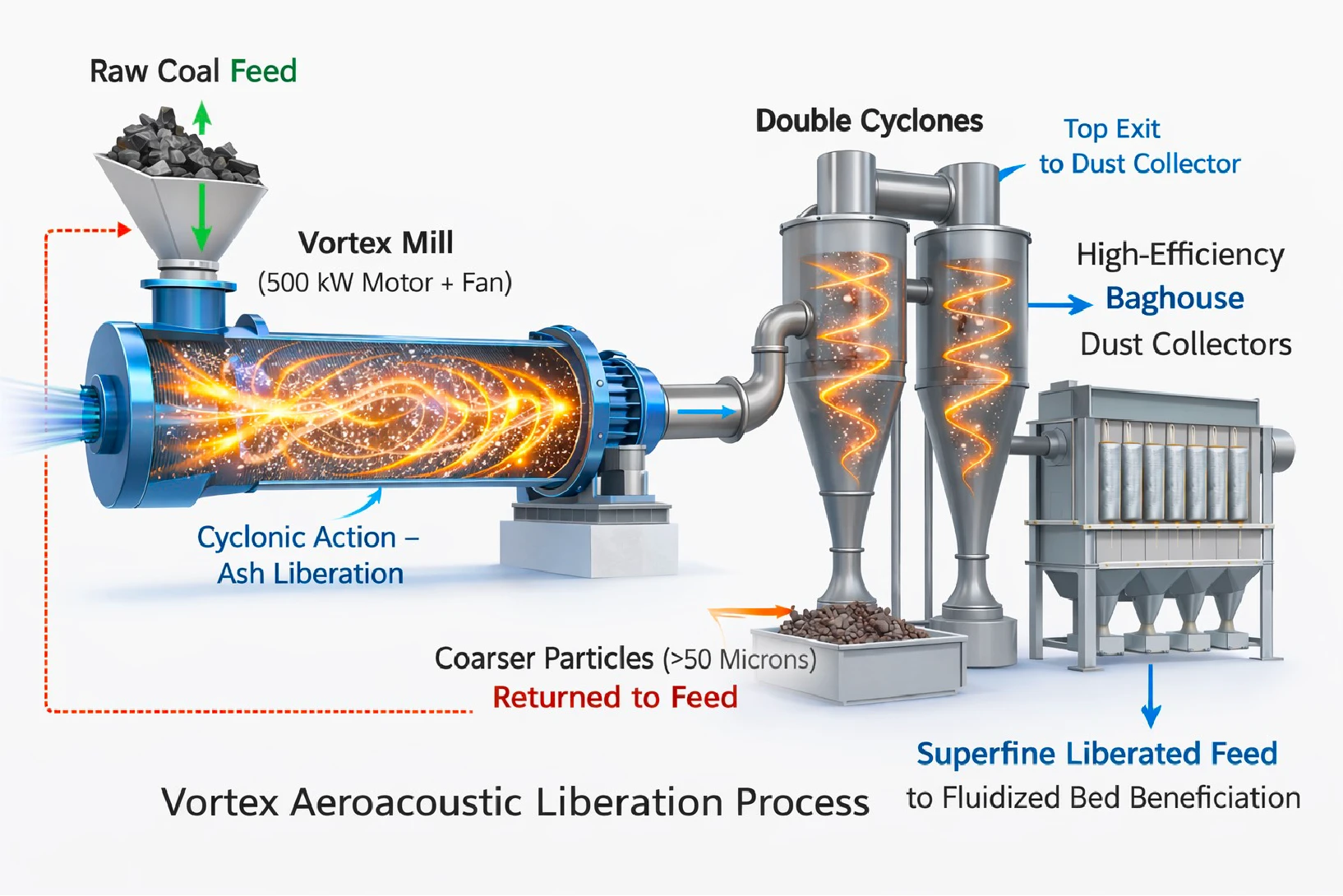
SUPER FINE ASH LIBERATION AT SUB 50 MICRONS
Aero acoustic milling technology for ultra-fine micronisation and enhanced surface properties.
The ARIA Aero-acoustic mill is an advanced air-driven technology that dries, micronizes, and activates materials in a single process. High-velocity vortex airflow generates heat and rapidly removes moisture without external drying systems. At the same time, particle-to-particle collisions reduce materials to micron-level sizes, increasing fineness and Blaine surface area.
Furthermore, the Vortex process creates jagged, irregular particle surfaces rather than smooth particles. As a result, it increases surface energy, exposes more reactive sites, and improves material reactivity. Consequently, the processed material delivers superior performance in cement, concrete, and other industrial applications.
In addition, combining drying, grinding, and activation into one step improves process efficiency and reduces operating costs. This integrated approach simplifies material processing, lowers energy consumption, and maximizes value from the same raw material feedstock.
FLY ASH TO SUPPLEMENTARY CEMENTITIOUS MATERIALS (SCM)
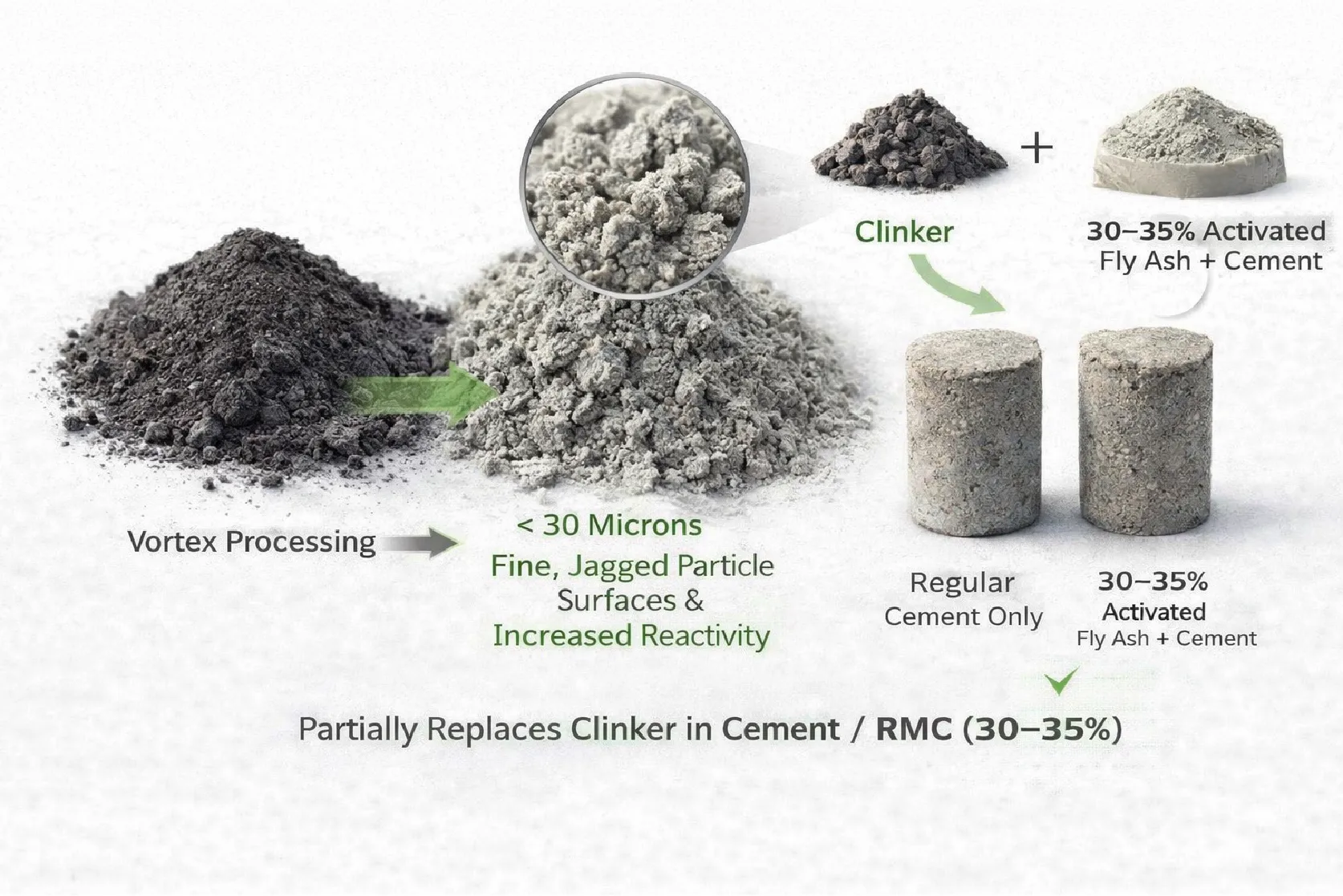
The Aero acoustic milling technology transforms fly ash into a high-performance supplementary cementitious material (SCM) by drying, micronising, and activating it to enhance its reactivity and bonding properties.
Fly ash is processed through the ARIA Aero-acoustic Mill to produce an ultra-fine material with particle sizes below 30 microns. The high-intensity vortex process increases fineness and significantly enhances Blaine surface area. Furthermore, high-velocity particle collisions create jagged, irregular surfaces that increase surface energy and expose more reactive sites. As a result, the pozzolanic reactivity of the fly ash improves substantially.
Consequently, the processed material performs as a high-quality Supplementary Cementitious Material (SCM) for cement and concrete applications. The enhanced reactivity enables the replacement of 30–35% of clinker without compromising compressive strength. In addition, the material improves durability while reducing the carbon footprint of cement production.
By converting fly ash into a premium SCM, the ARIA Aero acoustic milling technology creates a valuable waste-to-value pathway for the construction industry. This approach supports circular economy principles, reduces industrial waste, and increases the commercial value of fly ash resources.
GBFS TO SUPPLIMENTARY CEMENTITIOUS MATERIALS (SCM)
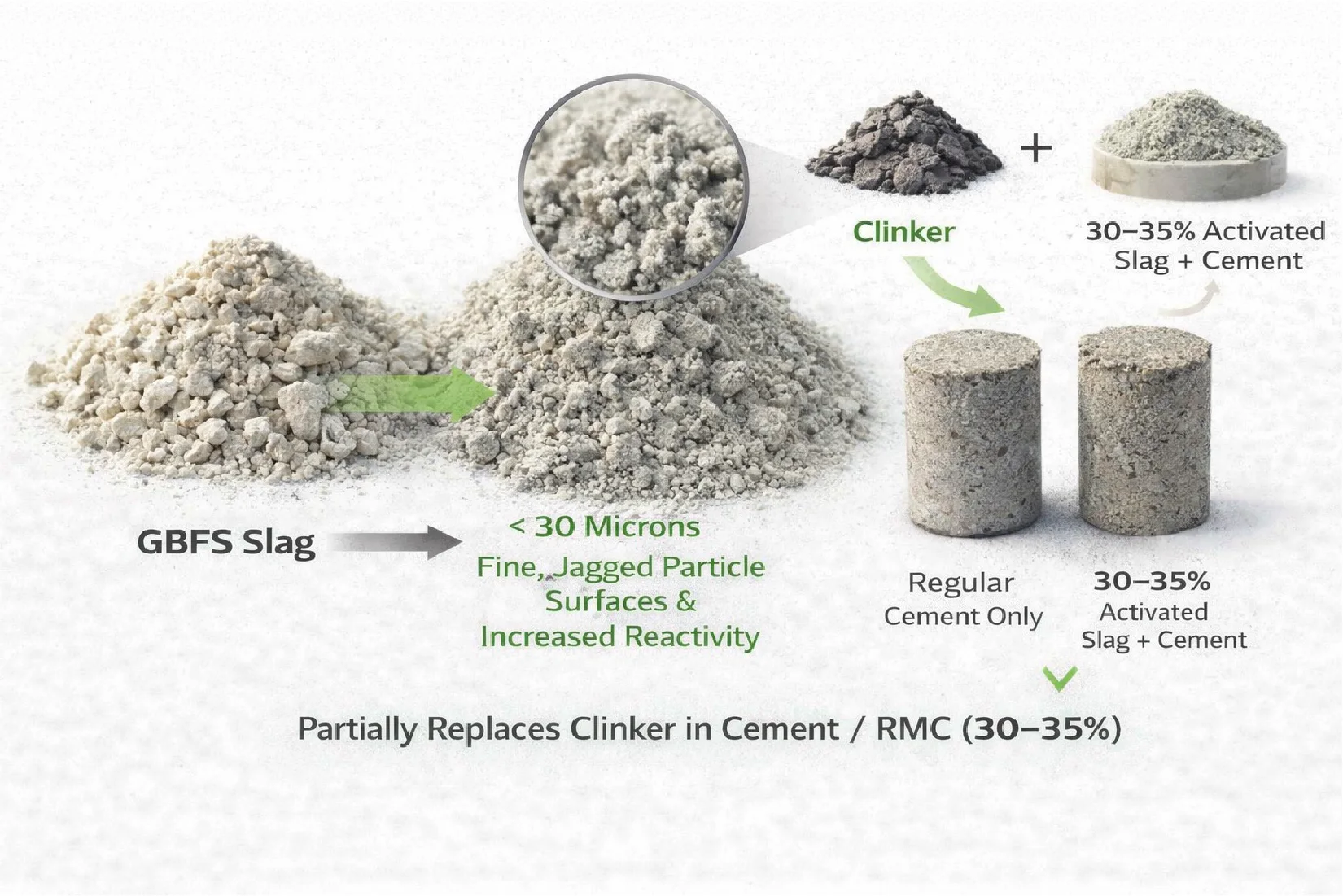
The ARIA Aero acoustic milling technology transforms GBFS into a high-performance supplementary cementitious material (SCM) by drying, micronising, and activating it to enhance its reactivity and bonding properties.
Granulated Blast Furnace Slag (GBFS) can be converted into a high-performance Supplementary Cementitious Material (SCM) through the ARIA Aero acoustic milling technology. The technology micronises GBFS to particle sizes below 30 microns, significantly increasing fineness and Blaine surface area. Furthermore, high-velocity particle collisions create jagged, irregular surfaces that expose more reactive sites and enhance hydraulic activity.
As a result, the activated GBFS delivers superior performance in cement and concrete applications. It can replace a substantial portion of clinker while maintaining or improving long-term compressive strength. In addition, it enhances durability, reduces the heat of hydration, and improves overall concrete performance.
Consequently, GBFS becomes a valuable low-carbon construction material that supports sustainable building practices. By converting an industrial by-product into a premium SCM, the ARIA Aero acoustic milling technology creates a waste-to-value solution that reduces carbon emissions, supports circular economy principles, and increases the commercial value of steel industry waste streams.
SCRAP GLASS TO CONSTRUCTION MATERIALS
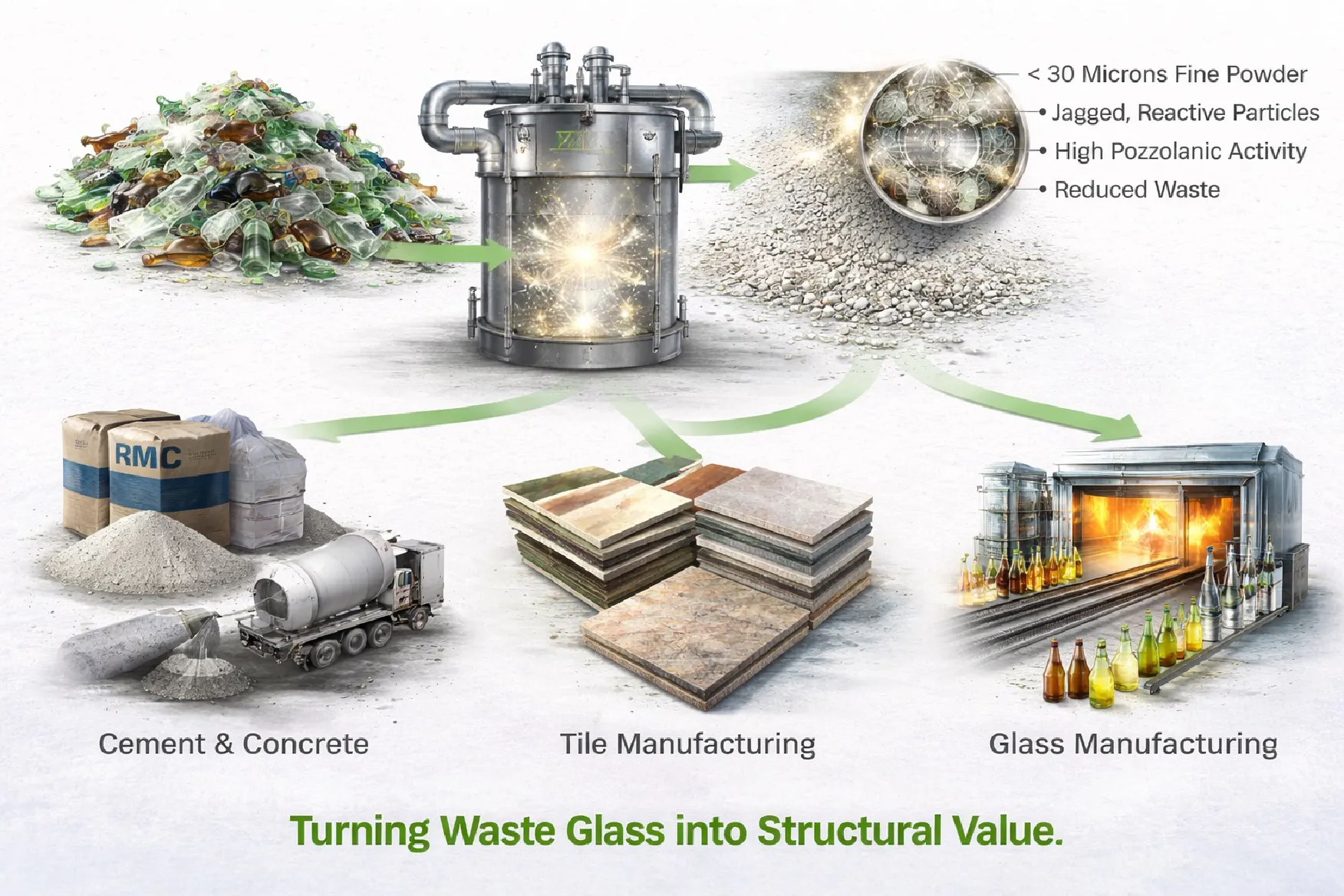
The Aero acoustic milling technology scrap glass into ultra-fine, highly reactive particles, enabling its efficient reuse in construction materials while reducing waste and simplifying processing workflows.
Waste glass can be transformed into a high-performance construction material through the ARIA Aero-acoustic milling process. The technology cleans, micronises, and activates glass particles using high-intensity vortex airflow and particle-to-particle collisions. As a result, the material achieves ultra-fine particle sizes, increased surface area, and jagged particle morphology that enhance bonding and reactivity.
Furthermore, the activated glass powder can serve as a high-quality Supplementary Cementitious Material (SCM) in cement and concrete applications. It can partially replace clinker while maintaining performance and durability. In addition, manufacturers can use the material in tile production to improve strength, surface finish, and product quality. The processed glass can also return to glass manufacturing as a premium recycled feedstock.
Consequently, the ARIA Aero acoustic milling technology converts waste glass into valuable industrial products. This waste-to-value approach reduces landfill disposal, supports circular economy principles, and creates new revenue opportunities from recycled materials. By maximizing resource recovery, the technology delivers both environmental and economic benefits for the construction and manufacturing industries.
ONE MACHINE MULTIPLE BUSINESS MODELS
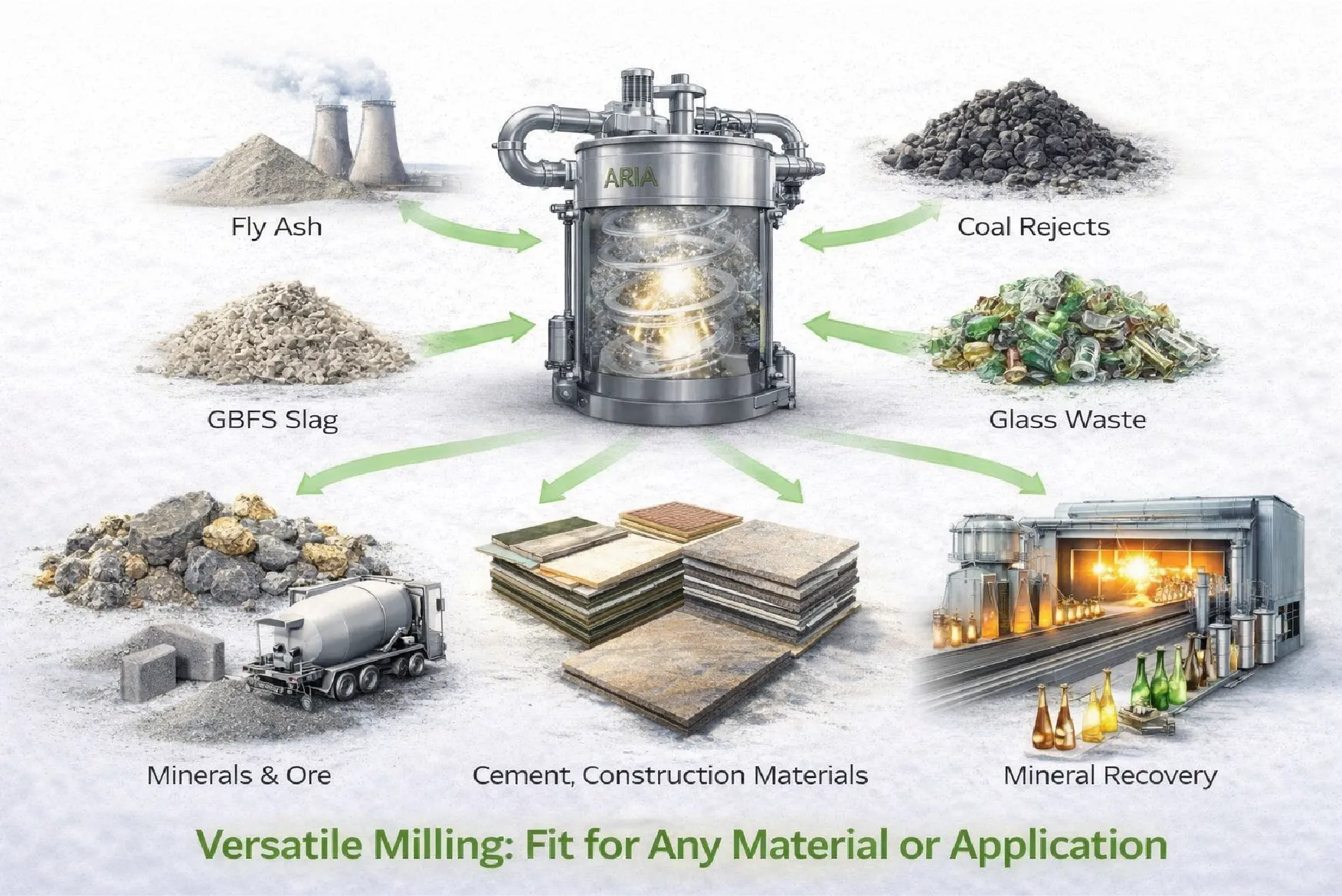
A Versatile Contactless Milling Plant Here To Replace Ball Mills.
The ARIA Vortex Mill is a contactless, air-driven milling technology that provides an advanced alternative to conventional ball mills. Instead of using grinding media and liners, it utilizes high-velocity particle collisions within a controlled vortex chamber. As a result, the process reduces wear, lowers maintenance requirements, and improves energy efficiency.
Furthermore, the system can process a wide range of materials, including fly ash, GBFS slag, coal rejects, waste glass, and mineral ores. It simultaneously performs drying, micronization, and surface activation in a single step. Consequently, the process produces ultra-fine particles with higher surface area, improved fineness, and enhanced reactivity.
In addition, the ARIA Mill improves performance in cement, construction, waste valorisation, and mineral processing applications. The technology reduces operating costs, simplifies process flowsheets, and delivers consistent product quality. By combining multiple processing stages into one system, the ARIA Aero-acoustic Mill offers a next-generation milling solution that can significantly reduce dependence on traditional ball milling technology.