ARIA MINERAL RECOVERY PLANTS
ARIA Mineral Recovery Plants transform coal-derived waste streams into valuable industrial products. The technology supports circular economy principles and promotes sustainable resource utilization. It recovers valuable minerals, metals, and industrial-grade materials from coal rejects, fly ash, bottom ash, and gasification residues. As a result, operators convert waste liabilities into revenue-generating assets.
Furthermore, the process reduces landfill disposal and maximizes resource recovery from mining and power generation operations. Unlike conventional disposal methods, ARIA creates a true waste-to-value pathway. It extracts economic value from discarded materials, reduces environmental impact, and improves overall project profitability.
In addition, the technology helps industries recover strategic raw materials from existing waste streams. This approach increases resource efficiency and reduces dependence on virgin mineral extraction. Consequently, companies can improve sustainability performance while creating additional revenue opportunities.
As industries place greater emphasis on resource efficiency and sustainable development, ARIA Mineral Recovery Plants provide a practical and commercially attractive solution. The technology advances the circular economy, unlocks new revenue streams, and maximizes value from industrial waste.
EXPLORE ARIA'S PLASMA BASED MINERAL RECOVERY PLANTS
SUPER FINE ASH LIBERATION AT SUB 50 MICRONS
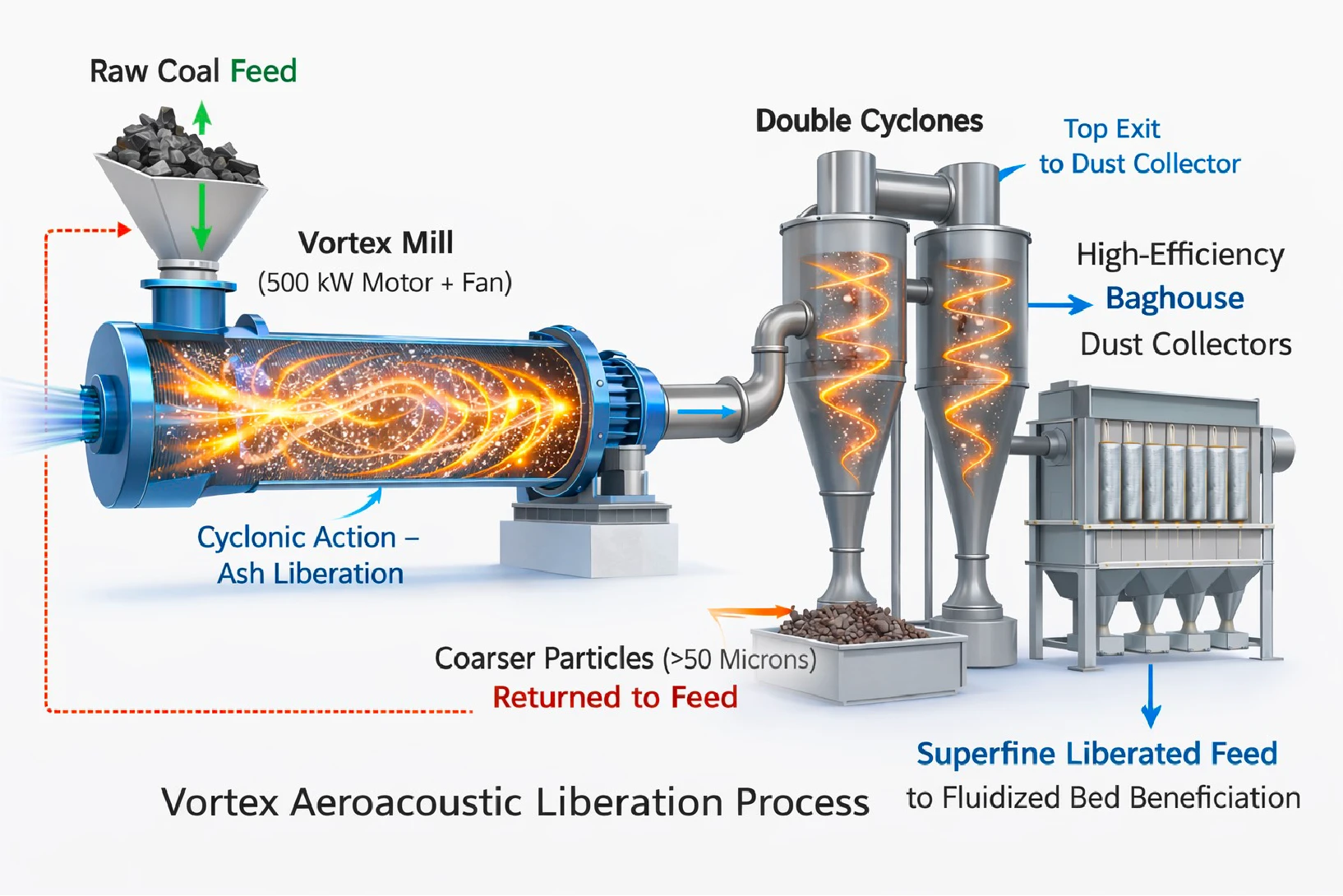
Vortex aeroacoustic technology for super fine ash liberation of drift theory Indian coal.
ARIA’s Vortex Aeroacoustics Technology is an advanced dry coal beneficiation process that uses high-velocity vortex airflow and acoustic energy to liberate ultra-fine ash from coal. Unlike conventional grinding systems, it achieves particle separation through particle-to-particle collisions, preserving coal quality and energy value. As a result, the process efficiently separates mineral impurities while maintaining the carbon-rich fraction.
Furthermore, ash liberation is critical for Indian coal, which often contains finely interlocked mineral matter. The ARIA Vortex process releases these ultra-fine ash particles and improves beneficiation efficiency. Consequently, it produces lower-ash, higher-calorific-value coal for power generation, coal gasification, and coal-to-chemicals applications.
In addition, the process operates without water, reducing operating costs and environmental impact. This approach supports cleaner coal utilization, higher resource efficiency, and greater value recovery. By upgrading low-grade coal into a premium energy feedstock, ARIA’s Vortex Aeroacoustics Technology improves profitability, reduces waste, and strengthens the sustainability of the coal industry.
SUPER FINE FLUIDIZED BED BENEFICIATION
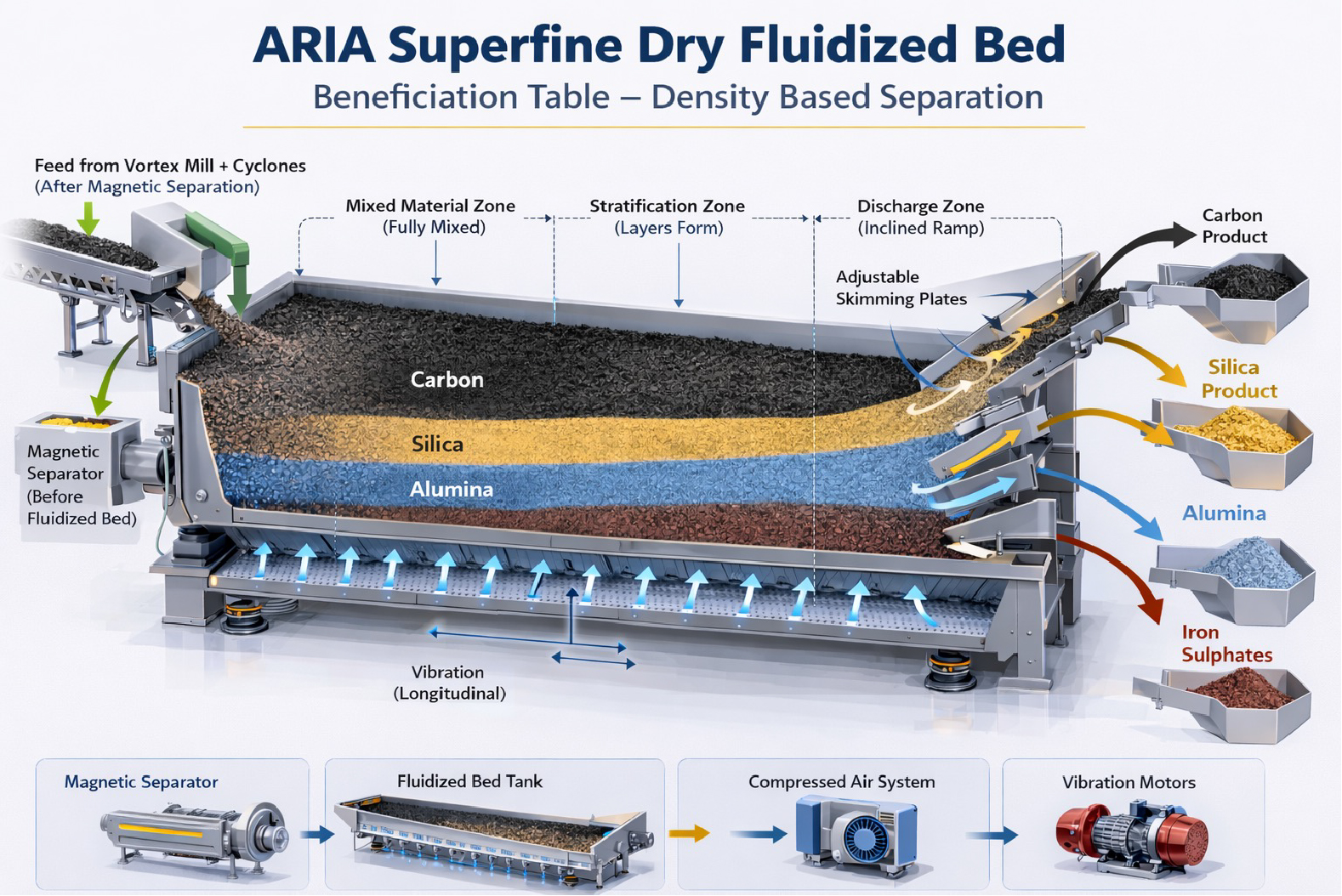
Density-based dry separation using air fluidisation and vibration to stratify superfine coal into distinct mineral layers without water.
The ARIA Superfine Dry Fluidised Bed Beneficiation Process is an advanced dry coal beneficiation technology that separates carbon from mineral impurities through density-based stratification. Superfine coal enters a vibrating fluidised bed, where controlled airflow and vibration create distinct layers of carbon-rich coal, silica, alumina, and heavier minerals.
Furthermore, the process operates without water, making it suitable for regions facing water scarcity. As the material moves across an inclined discharge ramp, adjustable skimming plates recover each layer into separate product streams. Consequently, the process upgrades carbon into low-ash, high-energy coal while recovering valuable mineral fractions for further processing.
In addition, the technology improves coal quality, increases beneficiation efficiency, and enhances downstream applications such as plasma gasification, power generation, and coal-to-chemicals production. By maximizing resource utilization and reducing waste, the process supports circular economy principles and improves profitability across the coal value chain.
WASTE TO VALUE FROM COAL REJECTS | MINERAL RECVOVERY PLANTS
Beneficiation rejects with alumina, silica and iron are converted to usable minerals by ARIA's Mineral Recovery Plants
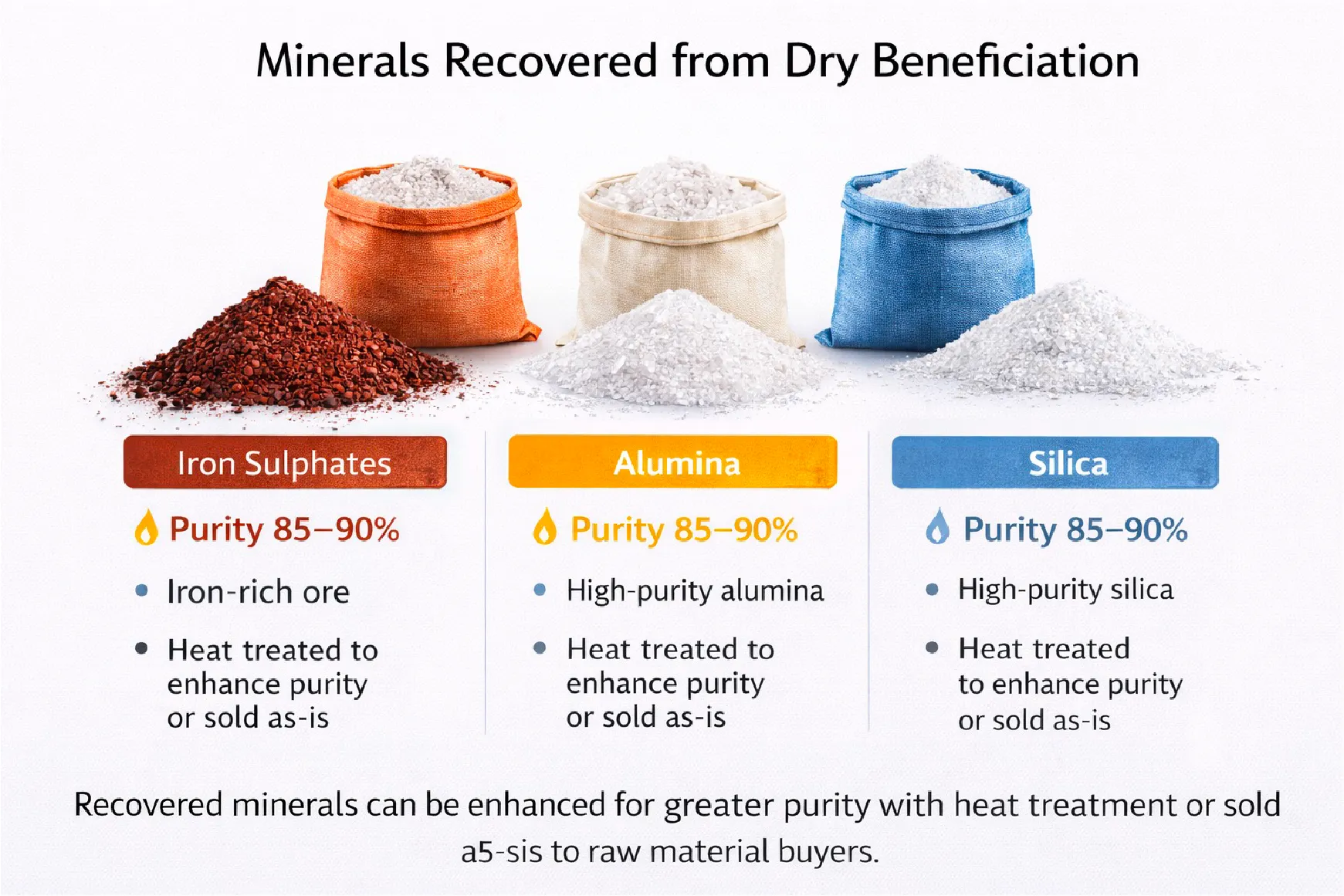
The ARIA Dry Beneficiation Process upgrades coal quality while recovering valuable mineral fractions through precise density-based separation. During beneficiation, the process separates mineral-rich streams from the carbon fraction and recovers industrial minerals such as silica, alumina, and iron-bearing compounds. As a result, waste materials become valuable commercial products.
Furthermore, the recovered mineral fractions can achieve typical purities of 85–90%. Industries can use these products directly or further upgrade them through refining and thermal processing. Consequently, they serve as valuable raw materials for cement, metallurgy, ceramics, glass, refractories, and chemical manufacturing.
In addition, mineral recovery creates a powerful waste-to-value opportunity for coal processing operations. The process generates additional revenue, improves resource utilization, and reduces waste disposal requirements. By supporting circular economy principles, ARIA enhances project economics and increases value recovery from every tonne of coal.
TARGETING THE RIGHT VALUE STREAM
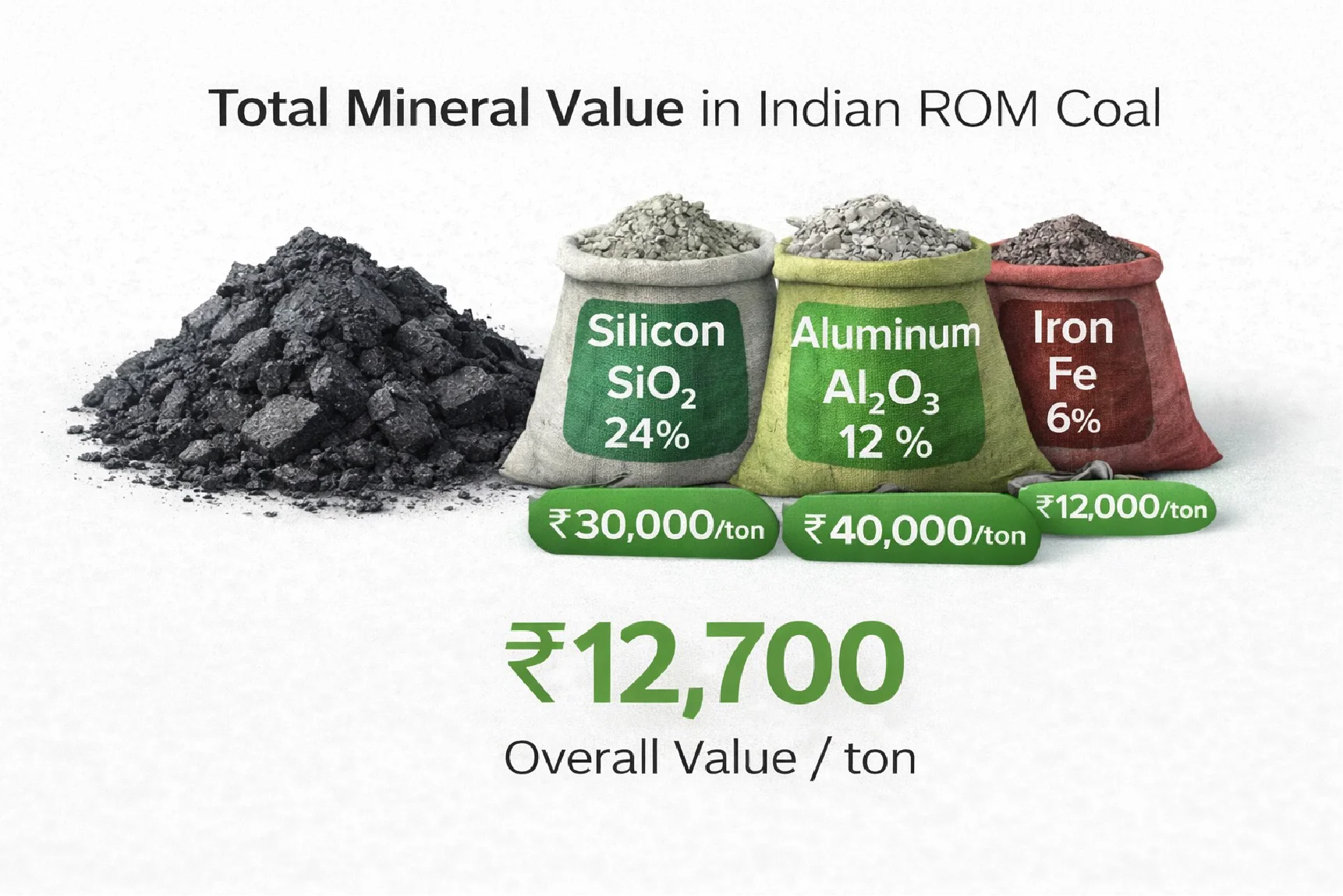
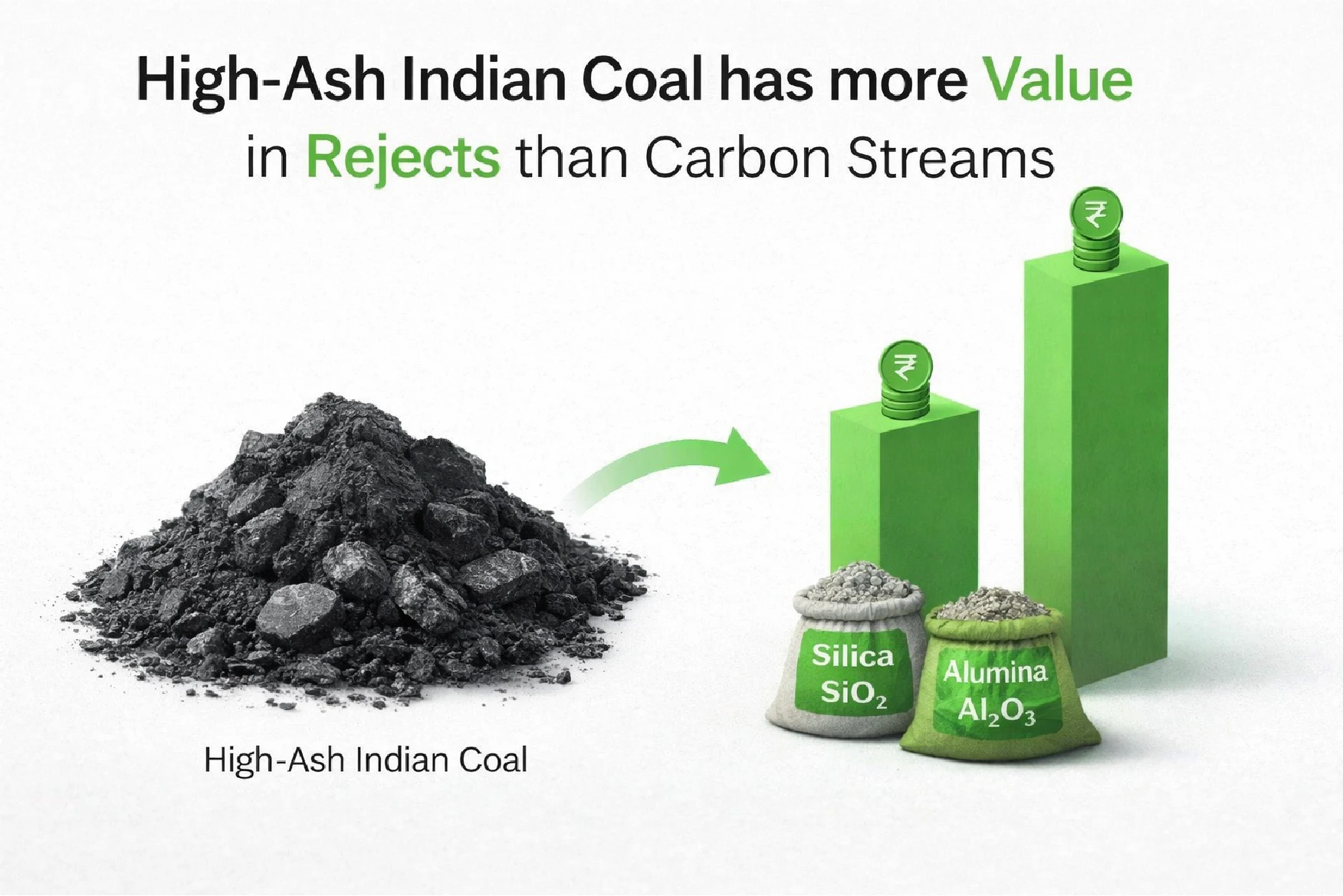
Indian high ash coal has much more value in rejects than the carbon streams itself.
Indian high-ash coal contains significant quantities of silica, alumina, and other valuable minerals within its reject streams. In many cases, these minerals have greater economic value than the remaining carbon. However, conventional coal processing methods often discard them as waste, resulting in lost revenue and additional disposal costs.
ARIA focuses on recovering, upgrading, and monetising these mineral-rich rejects. Through advanced beneficiation and mineral recovery technologies, the process converts waste streams into valuable products for the cement, ceramics, metallurgy, glass, and chemical industries. As a result, materials once considered liabilities become new sources of commercial value.
Furthermore, this approach reduces waste and maximizes resource utilization across the coal value chain. By recovering both energy and minerals from a single feedstock, ARIA creates a waste-to-value platform that supports circular economy principles. Consequently, coal beneficiation evolves into a high-value resource recovery business that delivers improved profitability, sustainability, and long-term growth.
EXTRACT MINERALS, MULTIPLY COAL PROFITS
What is often discarded as waste actually contains aluminium and silicon, minerals capable of generating far greater revenue than the carbon stream to boost cyclic Economy
India’s coal sector has historically operated on thin margins, limiting investment, innovation, and large-scale industry growth. Traditionally, coal has been valued primarily as a fuel, while significant quantities of valuable minerals contained within coal rejects have remained largely unutilised. As a result, substantial economic potential has been lost through conventional mining and beneficiation practices.
ARIA’s integrated beneficiation and mineral recovery technologies fundamentally change this model by unlocking the value of silica, alumina, iron-bearing minerals, and other industrial materials contained within coal-derived waste streams. Rather than treating rejects as a disposal challenge, the process converts them into marketable products that generate additional revenue and create new commercial opportunities. Consequently, every tonne of coal processed has the potential to deliver value beyond its energy content alone.
Furthermore, this waste-to-value approach improves resource efficiency and supports circular economy principles by maximizing the recovery of both energy and mineral resources. The additional revenue generated from mineral recovery enhances project economics, improves return on investment, and strengthens long-term profitability. As a result, the coal industry becomes more attractive to investors, more scalable for future expansion, and better positioned to support sustainable industrial growth across India.